January 2025 Investylitics

Horizon Advisor Network Investment Committee January 13, 2025
Executive Summary
- After robust performance during the first eleven months of a presidential election year, the markets have pulled back from early December. While the headline indexes, which are largely driven by large-cap tech and AI stocks, have dipped slightly, there has been more damage under the hood with equal weight and small-cap indexes.
- As President Trump prepares to assume office on January 20th, there is significant uncertainty about a number of tax and economic policies and their potential impact on the economy and the markets. We would like to remind you that this is true with every new administration.
- We have now experienced back-to-back years of 20% plus returns in the S&P 500 index. This leads many people to believe the markets are due for a downturn. However, while we expect more volatility in the upcoming year, history shows a more optimistic set of outcomes, which we will explore below.
- The Fed has its work cut out for it in the coming year as long-term interest rates continue to rise even as the central bank has cut short-term
- rates by 1% since September.
- Predictions for the market from the major banks and brokerage companies for the coming year show a wide range of dispersion. Maintaining disciplined diversification while managing liquidity and risk has historically proven to be a prudent strategy during times of uncertainty.
The Horizon Advisor Network Investylitics Committee members met on the afternoon of Monday, January 13th, in the afternoon to continue evaluating the investment and economic landscape as we enter the new year. As President Trump prepares to assume office on January 20th, there is significant uncertainty about a number of tax and economic policies and their potential impact on the economy and the markets. This is true of every new administration.
It also creates a lot of news and noise in the headlines, leading to many questions and concerns among clients and investors. We want to remind you that this is not a new phenomenon. In today's world of 24-hour cable news and social media, there is continual pressure to put out new headlines that generate clicks and readers.
To help illustrate this, we have included a chart below that shows just a sampling of headlines over the last 12 months that could have driven both markets and investor psychology.
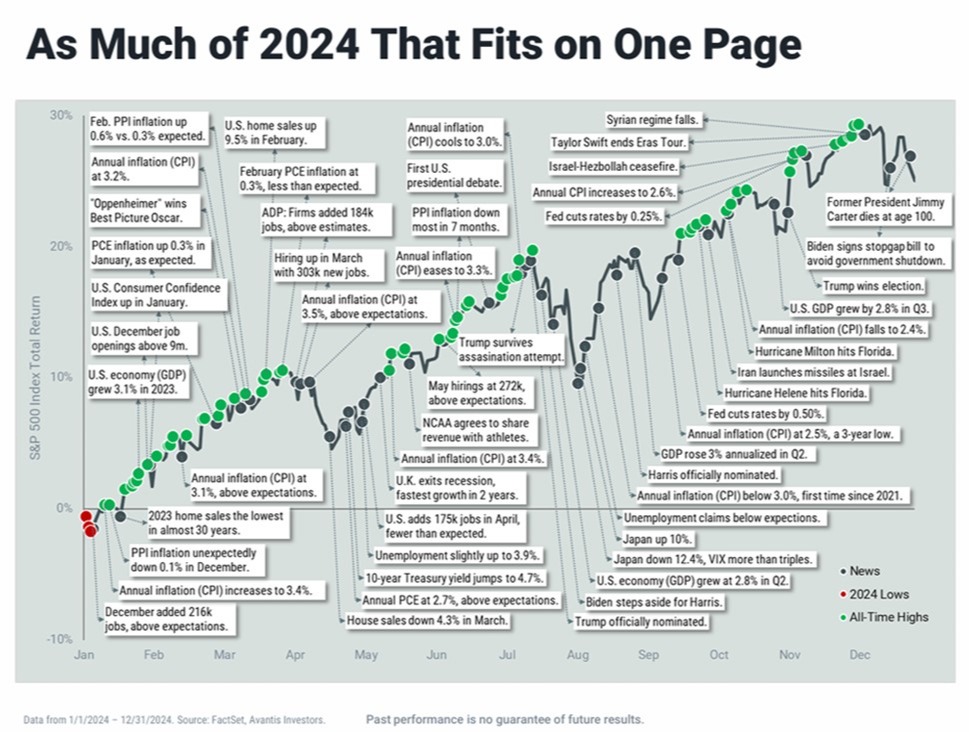
Since the S&P 500 index ended 2024 with a gain of more than 20%, it seems that ignoring the headline du jour and not interrupting the compounding of your portfolio was a wise strategy. We believe this will continue to be true going forward.
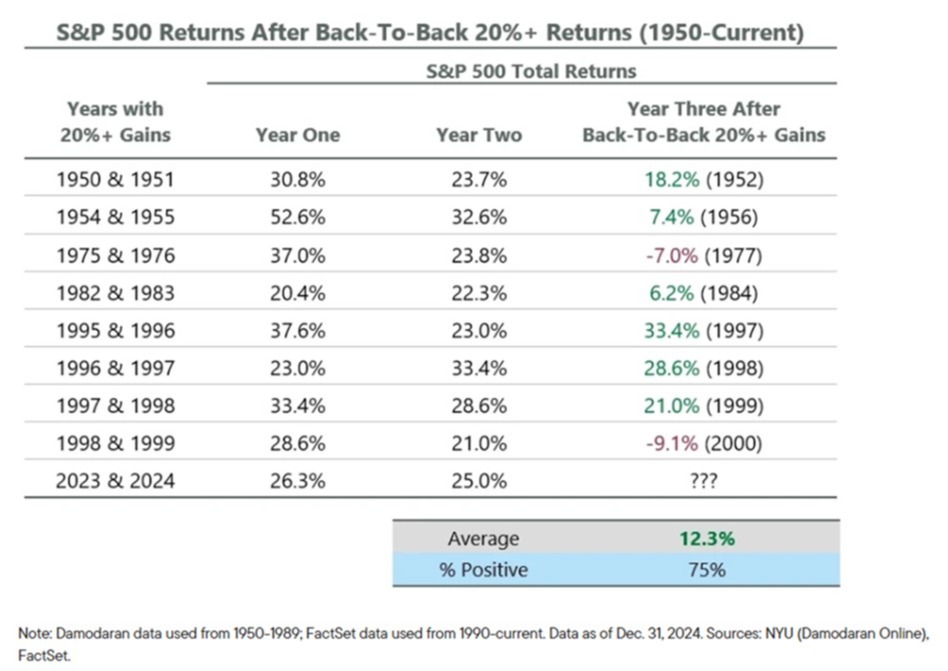
We have now experienced back-to-back years of 20% plus returns in the S&P 500 index. This leads many investors to believe the markets are due for a downturn. While we expect more volatility in the upcoming year, history provides a more optimistic set of outcomes, which is shown in the chart below. As you can see, since 1950, when the market has experienced back-to-back returns of 20%+, it has had more moderate but still positive returns approximately 75% of the time the following year. While this is no guarantee, history can provide some context for the future.
After notching the best 11-month return during a presidential election year since 1940, the markets have pulled back recently. While the headline indexes, which have been driven mainly by large-cap tech and AI stocks, have dipped slightly, there has been more damage under the hood with equal-weight and small-cap indexes. Since the market peak in early December, the equal-weight S&P 500 index has dropped nearly 8%, while small-cap indexes have dropped double digits.
The Fed will have its work cut out for it in the coming year as long-term interest rates continue to rise, even as the central bank has cut short-term rates by 1% since September. This means that each inflation and unemployment report going forward will be scrutinized more closely.
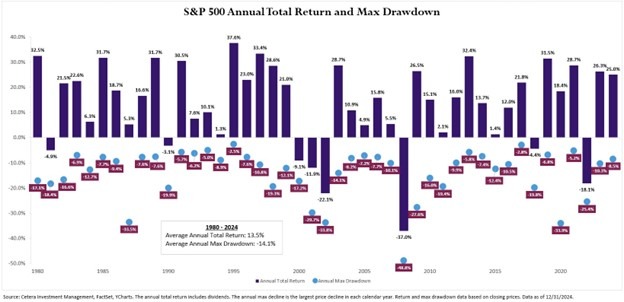
I know that we have shared our final chart below with you in the past. However, it is a helpful reminder that staying the course with the age and risk profile appropriate portfolio your advisor has constructed to help you meet your long-term goals has paid off over time.
Volatility is normal, even in bull markets. Since 1980, the S&P 500 has had an average calendar-year total return of 13.5%, with gains in 37 of 45 years, despite an average intra-year drawdown of -14.1%. It’s a classic case of “no pain, no gain.”